 Amazon US
 Amazon UK
 Amazon CA
 Amazon DE
 Amazon FR
How to save money on beauty products isn't just about finding the biggest discount. A 50% off email lands, you buy three mascaras, and two of them dry out before you reach the bottom. The discount was real, but the saving wasn't. The smarter approach is to look at what you will actually use, how long a product lasts and what it costs per use.
This guide shows you how to spend less on makeup, skincare, haircare and fragrance without filling your bathroom with products that expire, sit unused or end up in the trash.
Short answer: The best way to save money on beauty products is to buy products you will actually finish, compare cost per use instead of discount percentage alone, avoid stockpiling short-life cosmetics, shop genuine sale periods and check for eligible coupon or loyalty discounts before checkout.
How to Save Money on Beauty Products: Start With Cost Per Use
A percentage tells you what you saved at the register. Cost per use tells you what the product actually cost you by the time you finish it, stop using it or throw it away.
The formula is simple:
Cost per use = price paid ÷ the number of uses you will realistically get before the product expires or you stop reaching for it.
The second half of that formula is where a lot of beauty spending goes wrong. You should not divide the price by the theoretical number of uses in the bottle. Divide it by the number of uses you are realistically likely to get.
Here is the same purchase judged two different ways. These numbers are examples rather than current market prices, so substitute your own figures when comparing products.
| Purchase | Looks Like | Realistic Uses | Cost Per Use |
|---|---|---|---|
| 3 mascaras at 50% off, $12 each | $36 spent, $36 "saved" | ~90 if only one tube is fully used | $0.40 |
| 1 mascara at full price, $24 | $24 spent, no advertised saving | ~90 | $0.27 |
| 1 serum at 20% off, $40 | $40 spent, $10 saved | ~180 if used daily and finished | $0.22 |
The 50%-off purchase in this example actually costs more per use than buying one mascara at full price. The discount is genuine, but buying more than you can use destroys the saving.
That is why a modest discount on something you regularly finish can be a better deal than a huge discount on something you will eventually throw away.
Why Stockpiling Beauty Deals Can Waste Money
Beauty products do not last forever. Once a product is opened, exposure to air, heat, moisture, fingers and applicators can affect how long it remains suitable to use.
The FDA explains that U.S. law generally does not require cosmetics to display expiration dates. Manufacturers are responsible for determining product shelf life and safety, so the absence of a printed expiration date should not be interpreted as meaning a cosmetic lasts indefinitely.
Eye-area products deserve particular attention. The FDA notes that eye cosmetics tend to have shorter shelf lives, and manufacturers commonly recommend discarding mascara within a relatively short period after purchase.
That changes the math behind offers such as "buy two, get one free." If you cannot realistically use all three products while they are still suitable to use, the free item is not providing much real value.
Keep these practical points in mind:
- Preservatives do not work forever. Products can change as they age.
- Finger contact matters. Repeatedly dipping fingers into jars can introduce microorganisms.
- Storage matters. Heat and poor storage conditions can shorten a product's useful life.
- Eye products need extra care. Do not buy multiple mascaras simply because the percentage discount looks impressive.
Sunscreens and certain acne products are different because they can be regulated as drugs in the United States. Products that fall under drug requirements have different expiration and stability rules, making the printed date particularly useful when deciding whether buying an extra unit makes sense.
How to Save Money on Beauty Products Without Buying Less
Saving money on beauty does not necessarily mean giving up products you enjoy or automatically choosing the cheapest option. The goal is to spend more of your budget on products you actually use and less on products bought only because a sale created urgency.
Before buying, check what you already own. If you already have two unopened moisturizers, another 25% discount may not represent a useful saving. If you are almost out of the serum you use every morning, the same discount may be worth taking.
For every purchase, ask three questions:
- Will I actually use this?
- Can I finish it within a reasonable period?
- Is this the best final price available for the product I already wanted?
This simple check is one of the easiest ways to save money on beauty products without making your routine feel restrictive.
Mass vs Prestige Beauty: Which Offers Better Value?
A premium price does not automatically make a beauty product a better value, and a cheaper product is not automatically the smarter purchase. Compare performance, ingredients, how often you use it and cost per use.
Circana's U.S. beauty retail data for 2025 reported $72.7 billion in mass beauty sales, up 5%, compared with $36 billion in prestige beauty sales, up 4%.
| U.S. Beauty Retail, 2025 | Mass | Prestige |
|---|---|---|
| Dollar sales | $72.7 billion | $36 billion |
| Growth | +5% | +4% |
Source: Circana, U.S. prestige and mass beauty retail performance 2025.
The takeaway is not that mass beauty is always better. It is that shoppers have plenty of alternatives and should not assume a discounted prestige product automatically represents better value than a mass-market option.
If two products meet the same need, compare the amount you receive, how often you will use each one and the final price after any discount.
When Do the Best Beauty Discounts Usually Happen?
Beauty promotions move throughout the year rather than following one universal calendar. Instead of waiting for one exact date, learn the types of events that are worth watching.
- Retailer beauty events: Large beauty retailers often run multi-week promotional events with selected brands or categories discounted at different times.
- Loyalty offers: Member-only percentage discounts can sometimes reduce a wider basket than a normal product-specific promotion.
- Seasonal clearance: Seasonal beauty, skincare and body-care products may be reduced as retailers make room for the next season.
- Holiday shopping: November and the broader holiday shopping period can bring aggressive promotional activity across online retail.
- Brand-specific promotions: Individual beauty brands can run their own sitewide discounts, bundles, gifts with purchase or first-order offers throughout the year.
The important rule is simple: a sale should change when you buy something you already need, not convince you to buy something you never planned to use.
Beauty Deals: What to Buy, Wait For or Skip
Set your rules before the promotional email arrives. It is much easier to judge a discount when you already know what you need.
- Buy: A product you regularly finish when a meaningful discount appears and you know you can use it within its practical shelf life.
- Buy: A replacement for something you are nearly out of when the current price is genuinely competitive.
- Wait: An unfamiliar product that you have never sampled, especially if the only reason you want it is the discount.
- Wait: Premium products when a larger seasonal or loyalty promotion is likely and you do not need the item immediately.
- Skip: Large multipacks of short-life products such as mascara if you cannot realistically use every unit.
- Skip: Extra products bought solely to reach a free-shipping threshold when the additional spend exceeds the shipping fee.
- Skip: A backup of something you already own several unopened units of.
Beauty Shopping Mistakes That Quietly Cost You Money
- Judging a deal only by the percentage discount instead of the final cost per use.
- Buying backups without checking how much product you already have.
- Assuming a cosmetic without a printed expiration date lasts indefinitely.
- Buying foundation or concealer during a sale before confirming the correct shade.
- Choosing a larger size because it looks cheaper per ounce even though you rarely finish it.
- Storing beauty products in excessive heat or direct sunlight.
- Ignoring shipping costs when comparing prices between retailers.
- Buying enough unnecessary products just to unlock a gift with purchase.
- Checking out without seeing whether an eligible coupon code is available.
Before completing an order, browse current beauty and cosmetics offers to see whether an eligible discount is available.
How to Stack Beauty Sales, Coupons and Rewards
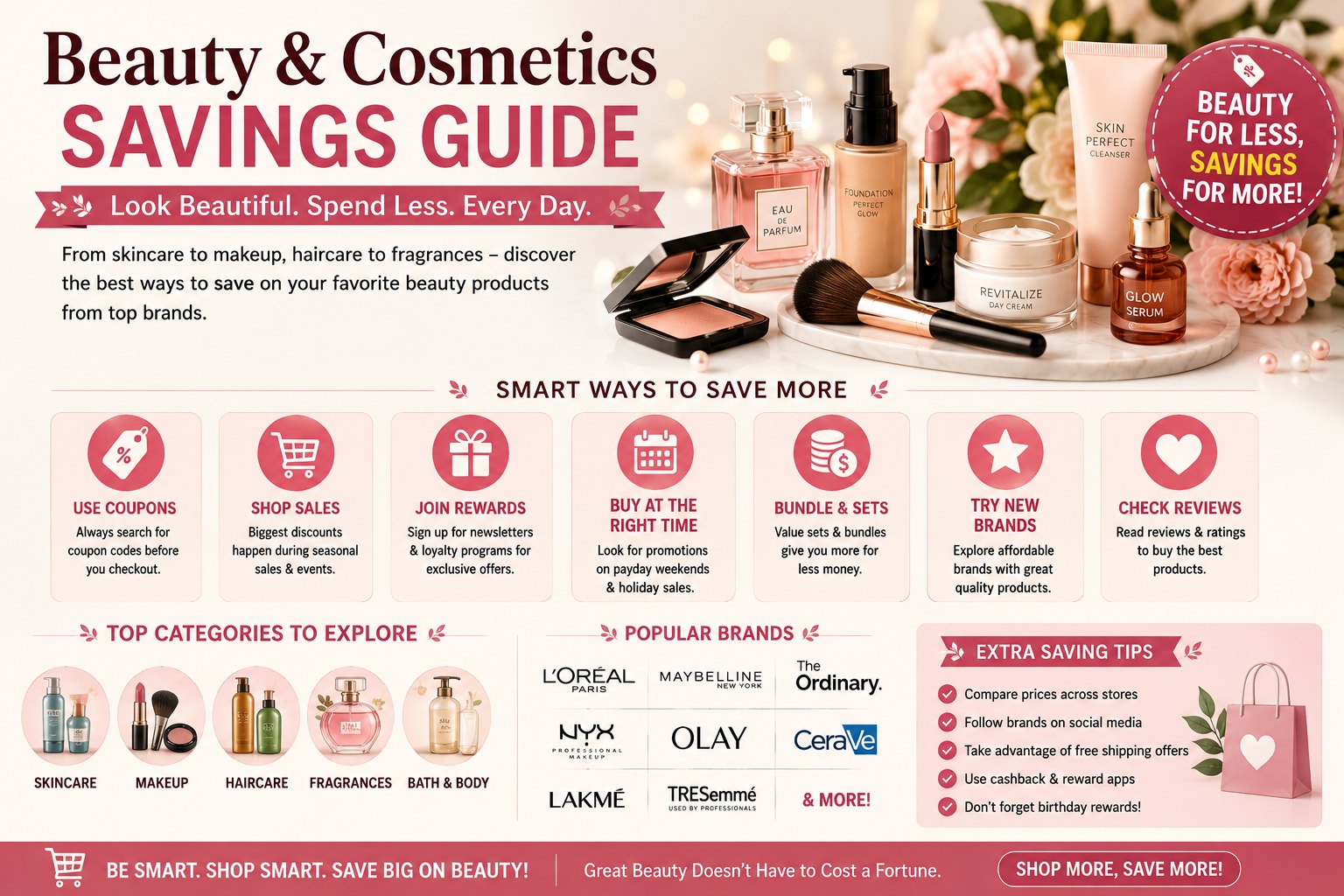
A good sale price can become even better when a retailer allows another saving method. The key is checking the terms rather than assuming discounts will or will not stack.
- Check the coupon before checkout. Look for an eligible code before placing the order.
- Test eligible codes on sale products. Some retailers exclude discounted merchandise, while others allow certain promotions to apply.
- Compare loyalty offers. A member-specific promotion may be stronger than a public coupon.
- Check student eligibility. Browse current student discounts when applicable.
- Consider refills. If you already own the packaging and genuinely use the product, a refill can sometimes reduce both cost and waste.
- Compare free shipping thresholds. Do not spend $20 on something unnecessary just to avoid a $6 shipping charge.
- Plan around major sale periods. Our sale calendar can help you decide whether to buy now or wait.
How to Build a Beauty Budget That Actually Works
One of the easiest ways to control beauty spending is to separate replacements from experiments.
Replacements are products you already use and expect to finish: cleanser, moisturizer, shampoo, mascara or another regular part of your routine. Experiments are new shades, trending products and formulas you have never tried.
Your replacement budget can take advantage of planned sales because you already understand your usage. Your experiment budget should be smaller because the chance of buying something that does not work for you is much higher.
Smart rule: Before buying a discounted beauty product, ask yourself: "Would I still want this if the sale banner disappeared?" If the answer is no, the discount may be creating the purchase rather than saving you money.
Frequently Asked Questions
How can I save money on beauty products?
Buy products you know you will use, calculate cost per use, avoid stockpiling short-life cosmetics, compare mass and prestige alternatives, shop genuine sale periods and check eligible coupons or loyalty offers before checkout.
What is the best way to save money on makeup?
Start with products you regularly finish. Compare the final price and cost per use, avoid buying duplicate shades or excessive backups, and check whether a sale, coupon or loyalty offer applies before ordering.
How long does mascara last after opening?
Eye-area cosmetics generally have shorter useful lives than many other cosmetics. The FDA notes that manufacturers commonly recommend discarding mascara within a relatively short period after purchase, so buying several tubes at once may not be economical if you cannot use them in time.
Do cosmetics have to show an expiration date in the U.S.?
Generally, cosmetics are not required under U.S. law to display expiration dates. Products regulated as drugs, such as certain sunscreens and acne treatments, are subject to different requirements.
Is it worth buying beauty products in bulk when they are on sale?
Only when you know you can use the products within a reasonable period. Bulk buying works better for products you consistently finish than for short-life or rarely used cosmetics.
Are expensive beauty products always better?
No. Price alone does not determine whether a product is right for you. Compare performance, ingredients, amount, frequency of use and cost per use before deciding between mass-market and prestige options.
What is cost per use?
Cost per use is the amount a product effectively costs each time you use it. Divide the price you paid by the number of uses you realistically expect to get from the product.
Should I buy beauty products during Black Friday?
Black Friday and the broader holiday period can offer strong beauty promotions, but a large percentage discount is only useful when it applies to something you genuinely need or planned to buy.
Is buying a larger beauty product always cheaper?
No. A larger size may have a lower price per ounce, but it becomes poor value if you cannot finish it. Compare both price per unit and realistic cost per use.
How do I know if a beauty sale is actually worth it?
Compare the final price with competing retailers, calculate how much of the product you will realistically use, check for restrictions and decide whether you would have bought the item without the promotion.
Related Beauty Savings Guides
- Beauty and cosmetics offers
- Health and wellness discount codes
- Student discounts
- Best time to buy: sale calendar
- Browse all coupon categories
- All verified stores and promo codes
- More GetMePromo savings guides
Sources: FDA, Shelf Life and Expiration Dating of Cosmetics · Circana, U.S. Prestige and Mass Beauty Retail Performance 2025
Prices, promotions, product formulas and retailer policies can change. Check current product information, offer terms and expiration information before purchasing.